“If your business operates in a high-risk sector, has complex foreign ownership, or uses offshore entities, your biggest threat is not your competition – it is your bank. Traditional banks do not run custom evaluations, they simply auto-reject any case that does not fit their standard templates. This widespread de-risking leaves legitimate, profitable companies cut off from global banking. We fix this by auditing your setups, repairing your compliance documentation, and designing multi-bank, multi-processor redundancy architectures that ensure your business never stops running.“
– Zeno Tonnis
(Former VP of Account Management @ Bivial AG)
Banks do not reject your high-risk, multi-entity, or foreign-owned business because they dislike you. They reject you because their own technology and correspondent networks are structurally unable to handle your complexity without risking their own business.
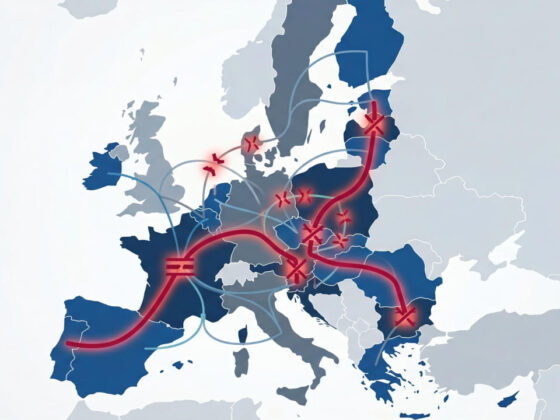
Smaller and mid-sized banks often want to work with high-risk or Web3 clients, but they cannot. They rely on large global correspondent banks to clear their US Dollar and Euro wires. If those massive clearing banks have a blanket ban on digital assets or specific high-risk jurisdictions, the smaller bank must drop you immediately to protect their own clearing lines.
Most banks use automated compliance software designed for simple, local retail businesses. If your corporate setup includes multi-sig wallets, parent-subsidiary structures across different borders, or ultimate beneficial owners (UBOs) in different countries, the system cannot process your file. Rather than doing manual, human review, their default compliance action is an outright rejection.
Traditional banks see brokerages, trading platforms, and high-volume platforms as a threat because they often commingle business cash with customer funds. Failing to cleanly separate client money from operational capital is a red flag that triggers immediate account freezes.
If your ultimate beneficial owners (UBOs) or directors hold Russian, Ukrainian, Pakistani, or other restricted passports, traditional banks will auto-reject your business. Even if you hold residency in Europe or operate a registered EU company, standard compliance filters flag these nationalities instantly. To pass, your corporate architecture must be structured with rock-solid local substance, flawless source-of-wealth documentation, and, where appropriate, compliant local nominee setups to satisfy bank risk algorithms.
Multi-tiered entity setups, parent-subsidiary structures across different borders, and offshore operational arms do not fit standard bank compliance profiles. Traditional KYC software is built for simple, local retail businesses. If your structure is complex, banks default to an outright rejection rather than paying for a manual, human compliance audit.
Licensed & supervised firms do not fail bank onboarding because of their license. They fail because of a disconnect between their traditional business story and their on-chain risk controls. To recover from a bank rejection, you must show clear separation between corporate funds and client crypto, proven wallet-screening systems (e.g., TRM Labs), and local operational substance.
A PPAC registered under Cyprus Law, Cap. 113, functions purely as a commercial agent. Because the agent coordinates payment routing on behalf of an offshore parent but does not hold, clear, or deal client assets directly, it does not require an expensive EMI or PI license from the Central Bank. It allows you to legally secure stable EU merchant accounts and business banking within weeks.
If your account is terminated and you have not implemented decoupled card vaulting, you lose your saved customer card data forever. Stripe will not migrate card data once an account is dropped. To prevent this single-point-of-failure event, high-risk firms must use independent, PCI-compliant vaults to store cards, keeping their customer data completely separate from any individual payment processor.
Serving as a local Nominee Director is not a paper-only arrangement; it carries strict personal and criminal liability for tax, corporate, and AML compliance under Cyprus Cap. 113 and the UK Companies Act 2006. To guarantee deep due diligence, continuous monitoring of payment lines, and real operational substance, Zeno Tonnis strictly caps these director mandates to a maximum of 10 active companies.
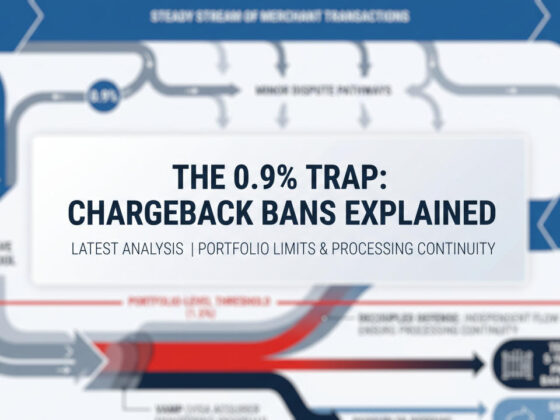
Visa calculates your Visa Acquirer Monitoring Program (VAMP) ratio by adding up your monthly fraud alerts (TC40) and your formal disputes (TC15), then dividing that total by your settled card-not-present transactions. The formula looks like this:
VAMP Ratio = ((Fraud Alerts + Disputes) / Total Transactions) x 100.
As of April 1, 2026, the threshold for merchants in the US, Canada, EU, and Asia-Pacific dropped from 2.2% to 1.5%. If you cross this 1.5% limit and process over 1,500 monthly cases, you face immediate penalty fees of $8 per incident.
Mastercard charges a $0.50 penalty fee for every declined card transaction attempt that it considers “excessive”. This fee applies when your system tries to charge the same card on the same merchant account after:
You receive more than 10 declines within a 24-hour period.
You receive more than 35 declines within a rolling 30-day period.
If your billing gateway has a simple “automatic retry” setting, you are likely bleeding money. To stop these fees, you must configure your payment system’s logic to block any further card attempts for 24 hours after a card has been declined 10 times. Instead of retrying a full authorization, your system should use an Account Status Inquiry (ASI) to verify if the card is valid, which is completely free of retry penalties.
When a mainstream payment provider (like Stripe or PayPal) shuts down your merchant account, they freeze your funds and refuse to let you migrate your saved customer credit card data to another provider. This means you lose your entire recurring subscription revenue overnight.
Decoupled card vaulting solves this by separation. Instead of storing credit cards inside your payment processor, you store them in an independent, PCI-compliant card vault (such as Spreedly or Basis Theory). Your website collects the card, stores it securely in the vault, and merely passes a temporary “token” to your processor.
If your primary processor shuts you down, you do not lose your customer data. You simply change a line of code in your backend to route those same customer cards to a backup processor.
Starting November 14, 2026, SWIFT and major clearing networks (like SEPA and CHAPS) will completely ban unstructured free-text postal addresses in payment messages. If you send an international payment containing a traditional, single-line address (e.g., “100 Main Street, London, UK”), the payment will suffer a hard rejection (NAK).
Under the ISO 20022 standard, you must use either a “hybrid” format (where the Town/City and Country are placed in dedicated fields, and the rest is free text) or a “fully structured” format (where every single element has its own tag).
To fix this, you must clean your vendor database and upgrade your ERP or Treasury Management System (TMS) to map address fields to the correct XML tags (specifically for the pain.001 format).

While accepting stablecoins (like USDC or USDT) provides 24/7 settlement and global reach, it introduces three major risks to your brokerage:
Provenance Risk: If your client deposits stablecoins that have previously touched a sanctioned or blacklisted wallet, your banking partners may freeze your entire corporate treasury account. You must integrate real-time blockchain analytics to scan and block high-risk wallets before you accept deposits.
Liquidity Fragmentation: Accepting payments across multiple networks (Ethereum, Tron, Solana) scatters your funds. You need real-time treasury orchestration to convert stablecoins back to fiat or rebalance your token pools.
Reconciliation Burden: Standard monthly reporting fails on 24/7 blockchain payments. Brokers must set up continuous on-chain tracking to match customer deposits with account ledger entries.
The transitional window for the European Union’s Markets in Crypto-Assets Regulation (MiCA) ends on July 1, 2026. Any crypto firm serving EU customers must secure a full MiCA CASP license by this date or wind down its operations.
To successfully obtain a license, crypto firms must meet strict criteria, including holding a set amount of physical capital reserves and verifying that client funds are held separately with regulated EU commercial banks.
Furthermore, under the new AMLD6 rules coming into force on July 10, 2026, there will be extreme scrutiny on complex corporate setups. You must prepare fully transparent documentation of all Ultimate Beneficial Owners (UBOs) and establish strong operational guidelines to satisfy European regulators.
The UK Financial Conduct Authority (FCA) is bringing cryptoassets fully under the Financial Services and Markets Act (FSMA). The application gateway opens on September 30, 2026.
Crucially, the FCA is applying the Senior Managers & Certification Regime (SM&CR) to crypto firms. Under SM&CR, senior executives (such as CEOs, CFOs, and Heads of Compliance) are personally and legally accountable for any operational failures, IT disruptions, or regulatory non-compliance in their business.
To prepare for authorization, firms must draft formal “Statements of Responsibility” (SoR) for each executive and prove they have institutional-grade internal controls, conflict management, and customer support channels in place.
Acquiring banks use rolling reserves to protect themselves from chargebacks. Typically, they withhold 5% to 15% of your daily credit card sales for 90 to 180 days.
If you are using a mass payment facilitator (like Stripe, Shopify Payments, or PayPal), reserves are often applied automatically by an algorithm without any negotiation.
To eliminate or drastically reduce a rolling reserve, you must leave mass payment aggregators. Instead, you need a dedicated merchant account underwritten individually by a specialized high-risk acquiring bank. By presenting clean product pages, clear refund policies, proactive chargeback alert systems, and proof of shipping delivery, you can secure custom Interchange-Plus-Plus (IC++) pricing with minimal or zero rolling reserves.
“Agentic Commerce” refers to buying experiences where autonomous AI agents (not humans) browse, select, and purchase goods. To make these transactions secure, Google developed the open Agent Payments Protocol (AP2).
AP2 provides a standardized, cryptographic framework for AI-led payments. It works using “Mandates”—tamper-proof, cryptographically signed digital contracts that serve as proof of a human user’s instructions. When a user tells an AI to buy a product, an “Intent Mandate” is created. When the AI selects the final items, the user’s approval signs a “Cart Mandate,” creating an unchangeable record of the exact items and price.
Because AP2 is payment-method-agnostic, your payment gateway must be upgraded to read and verify these cryptographic mandates, allowing you to capture automated sales from the AI-driven economy.
With the rise of AI-driven fraud, European regulators are warning financial platforms that basic identity checks are no longer sufficient. Fraudsters are actively using sophisticated deepfakes and manipulated videos to pass automated liveness checks during digital account openings.
To satisfy regulators, your technical onboarding infrastructure must move away from static, single-point checks. You must deploy a multi-layer identity defense system:
Integrate advanced liveness detection software designed specifically to identify AI deepfakes and manipulated video files in real time.
Replace rigid transaction monitoring limits with dynamic analytical scenarios that flag unusual account behavior.
Combine automated tools with device fingerprinting, IP-risk ratings, and geo-blocking to stop fraudsters before a payment is ever processed.