

The SEPA Discrimination Paradox: Why Legacy Bank Routing Defies the Single Market
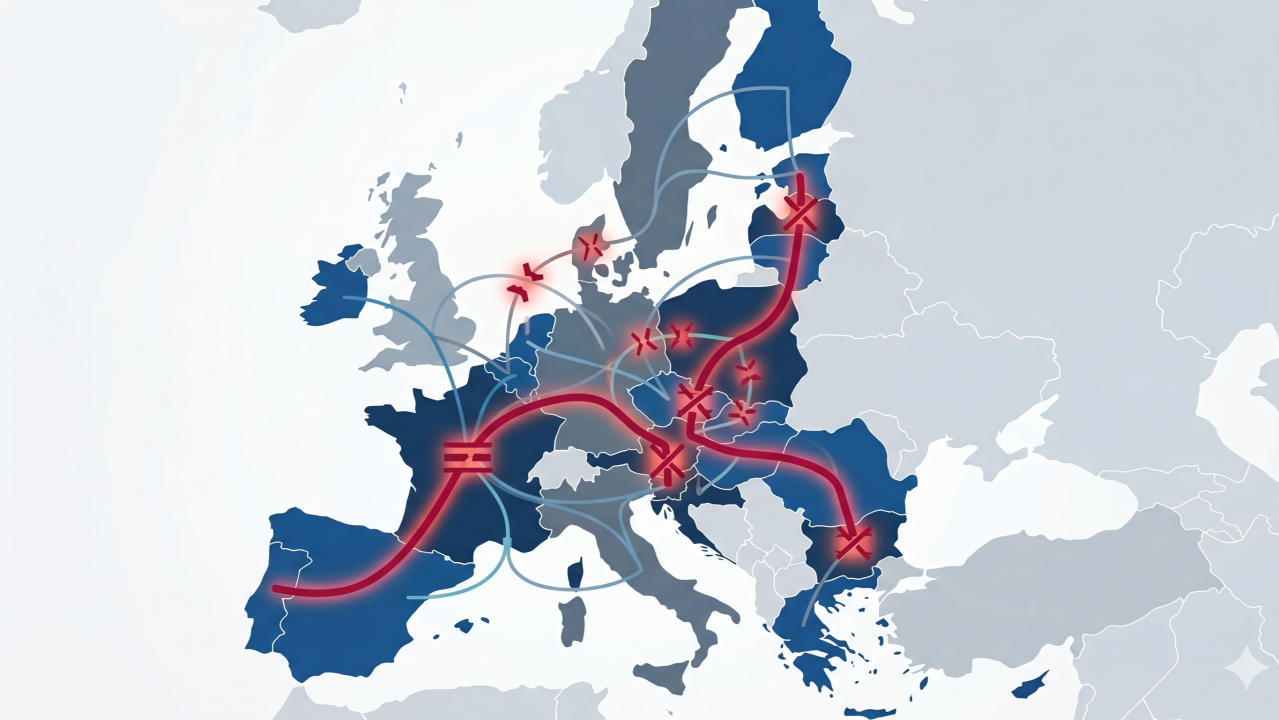
The legal promise of a unified European payment market routinely collapses when confronted by the legacy defensive routing logic of regional clearing banks. While Article 9 of the SEPA Regulation (EU) No 260/2012 explicitly prohibits merchants and financial institutions from rejecting non-domestic euro accounts, the operational reality tells a very different story. This systemic friction is not a simple compliance misunderstanding: it is an architectural failure of legacy transaction screening systems that default to blunt geographical blocking to isolate balance sheet risk.
Key Clearing Network Metrics
- Primary Technical Trigger: Hardcoded country-prefix database validation filters and non-EEA or challenger bank intermediary routing exceptions.
- Systemic Financial Impact: €260 billion in blocked or delayed cross-border transactions across the broader SEPA periphery annually.
- Average Settlement Drag: 48 to 72 hours of capital stagnation for rejected transactions requiring manual compliance review.
- Remediation Overhead: €150 to €300 per transaction in administrative and engineering labor to manually resolve routing failures.
For platforms coordinating mass global payouts or digital merchants relying on seamless collections, these blocks represent immediate balance-sheet leakage. In my view, relying on a single banking rail is no longer a viable strategy for high-stakes enterprise treasury. Honestly, I have seen platforms lose thousands in volume because their primary payment service provider failed to anticipate how EU correspondent networks evaluate non-domestic clearing pathways. To build a reliable payment stack, founders must move away from generic, single-partner banking models and adopt a highly redundant, multi-route architecture.
Why “SEPA-Compliant” Fails at the Counterparty
The mainstream narrative surrounding SEPA is simple: if a bank has signed the European Payments Council participation charter, transactions should flow seamlessly across all member states. This is a comforting myth. In reality, independent compliance departments at old-school European banks operate within highly isolated frameworks. They do not look left or right. If a transaction deviates from their rigid, domestic risk templates, their automated systems execute a silent block.
Historically, this issue manifested prominently in major consumer distribution platforms like Apple and Google Play, which historically restricted payouts to banks physically located within the consumer’s primary country. I was surprised to see how long these platforms maintained those structural barriers, even as the regulatory frameworks supposedly prohibited them.
Today, the problem has shifted deeper into the banking plumbing. It affects two primary areas:
                  [Initiating Payment Source]
                              │
             ┌────────────────┴────────────────┐
             ▼                                 ▼
   [Fintech / Challenger BIC]       [Swiss non-EEA SECB BIC]
   (e.g., LT, EE country codes)     (Double-hop clearing)
             │                                 │
             └────────────────┬────────────────┘
                              ▼
                      [EU Clearing Rail]
                              │
                              ▼
                      [Receiving Bank] ──► SILENT BLOCK (Legacy Risk Flag)
First, digital challenger banks and fintech platforms that issue Baltic (such as Lithuanian LT or Estonian EE) IBANs are routinely blocked by utility companies and tax authorities in Western Europe.
Second, Swiss financial institutions, despite processing compliant SEPA payments, must route their EUR transactions through the Swiss Euro Clearing Bank (SECB) in Frankfurt as a correspondent bridge to access European systems like TARGET2.
Understandably, CFOs are deeply concerned by these failures. They are caught off guard when legitimate business transactions are returned without clear explanations. The compliance teams at receiving European banks are not acting out of malice. They are simply operating under defensive guidelines where any transaction routed via an intermediary outside the European Economic Area (EEA) – or originating from a high-growth fintech hub – triggers a risk flag. Rather than investing in dynamic, transaction-level screening models, legacy institutions prefer to maintain blunt, geographic filters that prioritize absolute risk isolation over payment interoperability.
Hardcoded Regex and the Verification of Payee Bottleneck
To understand how these silent blocks happen, we must look at the software layer. When a digital merchant or utility provider sets up an onboarding form, their engineering team often uses generic business-to-business contract templates and standard payment validation scripts. These setups fail because independent compliance teams look directly at raw transaction data, which is the ultimate truth.
Many legacy validation scripts contain hardcoded regular expressions (Regex) designed to accept only domestic account patterns. A French utility company’s payment system, for example, might actively check if the inputted string begins with the FR prefix. If a customer enters a Spanish (ES) or Lithuanian (LT) IBAN, the front-end validation script rejects it immediately.
Even when the front-end allows the transaction to proceed, the payment often fails during interbank clearing. This occurs due to database misalignments and legacy fraud-prevention tools. The integration of the Instant Payments Regulation (Regulation EU 2024/886) introduces the mandatory Verification of Payee (VoP) scheme across Euro-area member states. While designed to combat invoice fraud and misdirected transfers, VoP has introduced fresh bottlenecks.
Legacy transaction-screening engines at receiving banks analyze the raw transaction data stream. When they detect a Swiss originating bank identifier code (BIC) paired with an SECB intermediary routing path, or a challenger bank BIC, their systems often fail to map this structure to standard EEA SEPA rails. The resulting rejection is rarely transmitted back to the sender with clear instructions. Instead, the transaction fails with cryptic ISO 20022 status reason codes:
MS03(Reason withheld by agent): This is the most common and maddening return code. It is a catch-all used by receiving banks to block a transaction on compliance or regulatory grounds without explaining the underlying issue. The receiving institution refuses to disclose the specific rule triggered, leaving the sender’s treasury team entirely in the dark.AG01(Transaction forbidden by the debtor agent): Often returned when legacy validation scripts on the debtor’s side misinterpret the SEPA scheme eligibility of non-EEA accounts, blocking the payment before it can reach the clearing channel.DNOR(Debtor bank not registered): A database misalignment where the receiving bank’s legacy system fails to recognize a valid SEPA scheme participant, despite its listing in the official registers.
Frankly, I admit that early in my career, I assumed SEPA was truly seamless across all member states. I was wrong. The reality is that the physical routing pathway of transaction data matters far more than any legal mandate. If a receiving bank’s automated compliance engine is configured to view foreign or fintech-issued BICs as elevated risk profiles, your payments will stall, regardless of how many regulatory guidelines say otherwise.
The Institutional Contrast
To understand why traditional setups fail, we must contrast standard corporate treasury architecture with institutional-grade, multi-route designs.
| Architectural Element | Standard Corporate Banking Stack | Institutional-Grade Multi-Jurisdictional Architecture |
| Routing Footprint | Single primary relationship with one clearing bank. | Distributed access across multiple local clearing systems. |
| Clearing Channels | Dependent on a single correspondent pathway (e.g., Swiss bank to SECB to EU). | Direct local clearing routes in Switzerland (SIC), the EU (TARGET2), and the UK (CHAPS). |
| Data Validation | Standard front-end regex validation with no correspondent route mapping. | Sequential indexing of bank metadata and real-time validation of recipient BIC routing paths. |
| System Failovers | Manual remediation of rejected transfers via alternative manual payment rails. | Automated fallback routing that switches clearing pathways instantly when a transaction is flagged. |
| Data Architecture | Static flat-file storage of payment details with no real-time audit trail. | Dynamic, ISO-compliant data schemas with integrated, unalterable system modification logs. |
The Conflict Mirror
This structural divergence is driven by a profound, ongoing tension within legacy institutions between processing speed and absolute risk containment.
“Our product teams are constantly demanding lower processing latencies to support real-time digital checkouts, but the reality is that the compliance architecture we inherit is completely unsuited for cross-border interoperability. When our filters flag a non-EEA routed transfer or an unfamiliar Baltic fintech BIC, the system defaults to a complete block because our compliance framework does not allow for real-time, multi-factor risk assessment of foreign intermediary rails. We would rather lose the transaction volume than risk a regulatory inquiry, and our systems are explicitly built to enforce that defensive trade-off.”
This institutional isolationism is precisely why modern fintechs are outperforming legacy players. While traditional banks hide behind their compliance frameworks, agile fintech platforms are designing payment stacks that can dynamically navigate these clearing bottlenecks.
Deploying a Multi-Jurisdictional Treasury Stack
To insulate your enterprise from IBAN discrimination and correspondent clearing failures, you must design a treasury stack that mirrors the geographic distribution of your transaction flows. Relying on a single bank account for European-wide collections is an invitation to transaction failure.
Instead, high-volume operators must establish physical and legal banking relationships across three distinct zones:
                      [Global Treasury Engine]
                                 │
           ┌─────────────────────┼─────────────────────┐
           ▼                     ▼                     ▼
     [CH Entity]            [EU Entity]           [UK Entity]
     (SIC System)          (TARGET2/EBA)         (CHAPS/BACS)
     Local CHF Rails       Direct EUR Rails      Local GBP Rails
By establishing local entities and direct banking relationships in Switzerland, the European Union, and the United Kingdom, you gain access to localized, domestic clearing rails. A payment destined for a French merchant is no longer routed via a Swiss correspondent bridge or a fintech-branded BIC. It is settled domestically within TARGET2 using your EU-based account.
This setup requires complex administrative coordination. You must establish local management authority, align with local tax structures, and configure your payment platform to execute dynamic, geographic routing. This is where many founders stumble. They use generic business-to-business payment setups that cannot handle dynamic routing logic. When a payout is initiated, their system simply sends all transactions through the same account.
To make this architecture work, your internal ledger must sequentially index every counterparty’s bank metadata. When a payment instruction is received, the routing engine must evaluate the destination BIC and match it with the optimal clearing channel. If the recipient bank is located in a country known for high rates of foreign IBAN rejection, such as France, Spain, or Germany, the system must automatically divert the payment to your local EU-based account, entirely bypassing the intermediary or non-domestic routing rails.
The MiCA Parallel and the Future of Sovereign Compliance
This pattern of operational fragmentation is not unique to SEPA clearing rails. We are seeing a very similar dynamic unfold with the implementation of the Markets in Crypto-Assets (MiCA) regulation. Although MiCA was designed to establish a harmonized, pan-European regulatory framework for digital assets, individual national regulators are already interpreting the rules through localized lenses. Each country is building its own administrative setup and imposing distinct operational expectations on virtual asset service providers.
This tells us something fundamental about the future of global financial plumbing. Written regulations will never guarantee structural consistency. No matter how many unified frameworks are passed by the European Parliament or the European Commission, the execution of those laws remains highly fragmented. Compliance departments will always interpret risk through localized, sovereign frameworks to protect their own balance sheets.
The only way to win in this environment is to build sovereign-agnostic infrastructure. Do not design your systems around the assumption that the single market is truly unified. Instead, assume that every national border is a potential clearing bottleneck. By deploying local infrastructure, maintaining multi-bank redundancy, and utilizing automated, dynamic routing, you can insulate your business from the legacy friction that continues to choke traditional banking channels.
Strategic P&L Safeguards
If you are a fintech founder or a platform payment architect, you should take immediate, tactical steps to audit your payments pipeline:
- Extract Your Payment Logs: Run a comprehensive report on all SEPA credit transfers and direct debits over the last 12 months. Filter specifically for rejections containing codes
MS03,AG01, andDNOR. - Map the Correspondent Paths: Identify which of your partner banks utilize SECB, offshore, or high-risk challenger bank intermediary routing pathways for euro transactions.
- Implement Multi-Routing Failovers: Configure your payment stack to automatically detect a rejected cross-border transaction and instantly re-route the payment through an alternative, domestic clearing channel.
- Establish Multi-Jurisdictional Entities: Set up banking relationships in Switzerland, the EU, and the UK to ensure you always have a direct, localized routing path available for key customer regions.
The future of transactional banking belongs to those who control their routing rails. While legacy banks remain locked in their rigid compliance frameworks, forward-looking platforms can turn payments infrastructure into a distinct competitive advantage.
Sources
- European Commission: SEPA and IBAN Discrimination Guidance (2024-2026) https://finance.ec.europa.eu/consumer-finance-and-payments/payment-systems/sepa_en
- European Commission: IBAN Discrimination FAQ and Reporting Mechanisms https://finance.ec.europa.eu/consumer-finance-and-payments/payment-systems/iban-discrimination_en
- Regulation (EU) No 260/2012: Establishing Technical and Business Requirements for Credit Transfers and Direct Debits in Euro (SEPA Regulation) https://eur-lex.europa.eu/legal-content/EN/TXT/?uri=CELEX:32012R0260
- European Central Bank: Retail Payments Strategy and SEPA Integration https://www.ecb.europa.eu/paym/retpaym/sepa/html/index.en.html
- SECB Swiss Euro Clearing Bank: SEPA Processing Services and euroSIC Interoperability https://www.secb.de/en/home/services.html
- European Payments Council: SEPA Credit Transfer and Direct Debit Scheme Rulebooks https://www.europeanpaymentscouncil.eu/what-we-do/sepa-direct-debit-schemes/rulebooks
- De Nederlandsche Bank (DNB): SEPA Regulations and Sanctions for IBAN Discrimination https://www.dnb.nl/en/payments/how-do-payments-work/sepa-and-iban-discrimination/