
The Card Network Threshold Trap – Why Low Dispute Ratios Trigger Long Term Processing Bans for Enterprise Platforms
Platform executives frequently assume that maintaining an off-the-shelf dispute ratio below card brand thresholds guarantees operational survival. In reality, modern digital clearing screening networks deploy pre-emptive automation that blacklists processing entities long before public limits are breached. This structural disconnect leaves high-volume enterprises incredibly vulnerable to sudden network exclusion, showing that surface compliance metrics are often a dangerous illusion.
TECHNICAL TRIGGER: Visa VAMP 1.50% / Mastercard ECP 150 BPS Dual-Breach Threshold
SYSTEMIC ACTION: Automated Acquirer Portfolio De-risking and Pre-emptive Merchant Termination
UBO PENALTY: MATCH List Registry Placement under Reason Code 14 (Excessive Disputes)
FINANCIAL CONSEQUENCE: Complete Card-Not-Present Settlement Blockade and 5-Year Processing Ban
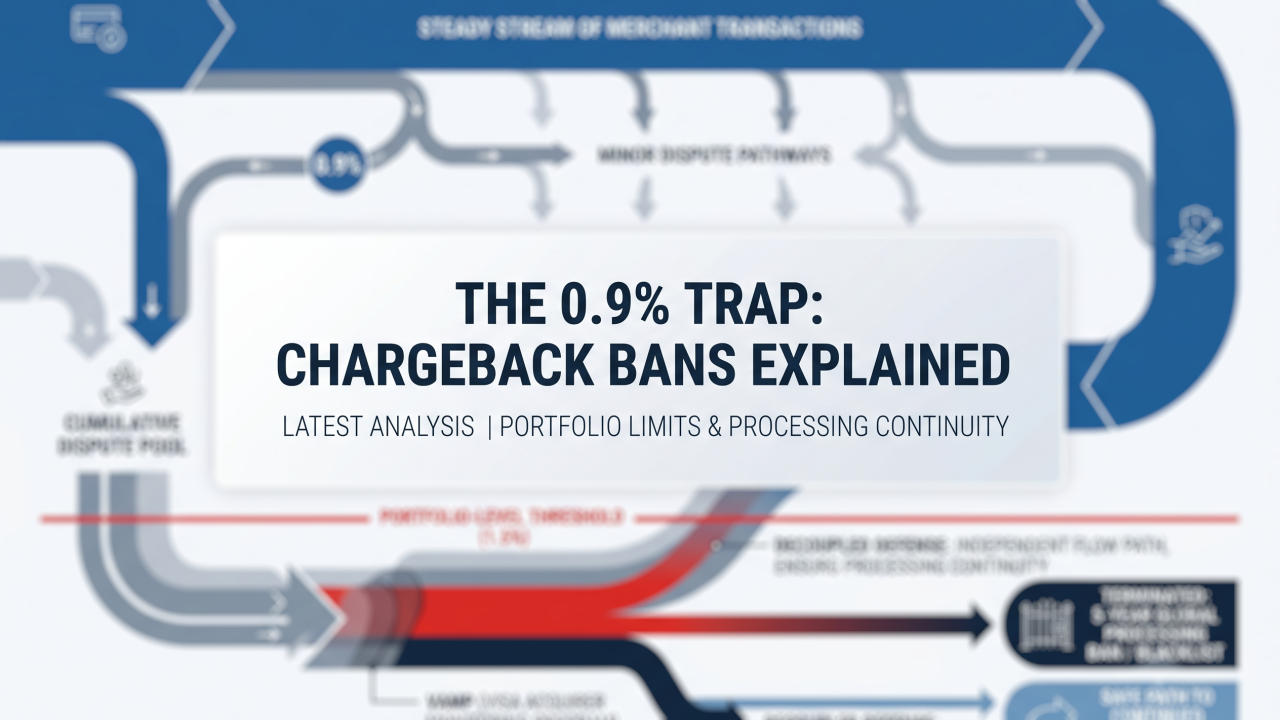
The core of this systemic trap lies in how clearing institutions must manage their aggregate portfolio risk. Under modern clearing frameworks, the risk limits of individual merchants are subordinately tied to the survival limits of their acquiring banks. Honestly, I find it deeply concerning how few treasury teams understand this dynamic. When a merchant operates at a steady 0.9% dispute ratio, they believe they are safely below the public 1.5% ceiling.
Yet, when we look at the transaction data, we see that acquiring banks face massive, compounding operational fees if their entire merchant portfolio breaches aggregate network limits. To protect their own clearing licenses, banks execute pre-emptive terminations. They terminate the platform first, ask questions later, and place the ultimate beneficial owners on global blacklists. This systemic reality turns a seemingly safe operation into an overnight corporate nightmare.
The Illusion of the 3D Secure Safety Net
I regularly observe founders relying on 3D Secure – 3DS – as an impenetrable shield. It is a common, and highly dangerous, administrative shortcut. The prevailing industry assumption is simple: by routing transactions through 3DS protocols, the platform shifts financial liability for fraudulent chargebacks back to the card issuer. If a dispute occurs, the issuing bank pays, and the platform remains financially whole. This is a massive trap.
While 3DS successfully relocates the immediate financial liability of a fraudulent transaction, it does absolutely nothing to scrub that transaction from the card network monitoring metrics. Under Visa Acquirer Monitoring Program – VAMP – and Mastercard Excessive Chargeback Program – ECP – rules, a dispute is counted as an indicator of systemic risk regardless of who pays for it. Every single dispute, whether liability-shifted or not, increments the merchant’s ratio.
I remember watching a high-volume subscription platform face this exact reality last year. Their growth team was thrilled because they had scaled transaction volume while shifting 95% of their fraud disputes to issuing banks. However, their raw VAMP ratio was quietly climbing to 1.6%. The treasury team was completely caught off guard when their principal acquirer terminated their merchant agreement with forty-eight hours of notice. The platform lost its ability to process payments instantly, even though their direct chargeback write-offs were practically zero.
The clearing bank did not care about the liability shift. They cared about their own systemic exposure to Visa’s portfolio-level penalties. Reliance on 3DS as a risk-mitigation strategy is a superficial shortcut that ignores the raw mathematical formulas governing clearing bank operations.
Deconstructing the Double-Counting Trap and Real-Time Latency Asymmetry
The technical mechanics of modern card networks are designed to protect the system, not the merchant. Visa’s VAMP calculation methodology relies on a formula that merges two distinct datasets:$$\text{VAMP Ratio} = \frac{\text{TC40 (Visa Fraud Reports)} + \text{TC15 (Disputes)}}{\text{TC05 (Total Settled Transactions)}}$$
This formula creates a brutal double-counting trap. When a cardholder notices an unauthorized transaction, they typically report the fraud to their issuing bank. The issuer immediately generates a TC40 Fraud Report. Following this, the issuer files a formal TC15 Dispute to claw back the funds.
Because both actions are logged under the same transaction identifier, the single event is counted twice in the platform’s VAMP numerator. If a platform experiences a bot-driven card-testing attack, this double-counting mechanism can artificially push a 0.8% dispute ratio to a 1.6% ratio overnight.
Furthermore, there is a severe latency asymmetry in how this data is distributed. I have seen countless operational teams review their internal dashboards, believe their processing is perfectly healthy, and then get blindsided by a month-end compliance warning.
This happens because issuing banks have up to 120 days – and sometimes up to 540 days for travel or future-delivery services – to file disputes. While the platform sees clean transaction data in real-time, the clearing bank is quietly accumulating delayed TC40 and TC15 files.
[TC05 Settled Transaction (Day 1)]
       │
       ├─► [TC40 Fraud Report Filed (Day 15-45)] ──► Cumulative Acquirer Exposure
       │
       └─► [TC15 Dispute Processed (Day 45-120)] ──► Aggregate VAMP Ratio Spike
By the time the platform realizes their ratio has spiked, the clearing bank has already initiated de-risking protocols.
Let me refine that. The latency is actually worse than a simple reporting delay. Issuers are under no regulatory obligation to share TC40 data with merchants in real-time. It remains a hidden, silent signal.
For small-value transactions, issuers will often generate a TC40 report but skip the TC15 dispute process because the administrative cost of the clawback exceeds the transaction value. The merchant never receives a chargeback, yet their risk profile is systematically degraded behind the scenes. It is an exhausting, invisible drain on corporate processing stability.
Inside the Clearing Bank: The Preemptive Termination Equation
To understand why platforms are terminated before they officially breach card brand rules, we must examine the risk psychology of bank credit committees. For a clearing bank, credit card processing is a high-volume, low-margin utility.
The bank earns a fraction of a percent on processing fees but faces extreme, escalating fines from Visa and Mastercard if their aggregate merchant book is labeled as “Excessive” under VAMP or ECP. This imbalance shapes their risk mitigation behavior.
“The structural reality of global transactional banking is that no individual merchant’s fee volume can ever justify the existential risk of a clearing bank losing its principal membership status with Visa or Mastercard. When an aggregate portfolio starts pushing toward network penalty zones, the clearing bank’s internal credit committee will always choose to unilaterally terminate the high-risk, high-velocity nodes. They will actively sacrifice an enterprise client to preserve the integrity of their clearing license, utilizing pre-emptive contract clauses to offload systemic compliance costs down to the platform.”
When a platform reaches a 0.9% dispute ratio, it represents a ticking clock to the bank’s risk officers. If Visa detects that an acquirer’s aggregate portfolio has too many merchants exceeding 0.5% in fraud and disputes, the bank is forced into mandatory remediation.
The bank must pay between eight and ten dollars for every single disputed transaction across their entire client base. The math is frankly terrifying for the bank. A single volatile merchant can erase the profitability of the bank’s entire merchant-acquiring division.
Consequently, the bank’s risk committee does not wait for the merchant to reach the official 1.5% threshold. They calculate the merchant’s margin-to-penalty ratio and execute a pre-emptive termination under “Reason Code 14” – Excessive Disputes.
Systemic Isolation: Why UBO Tracking Defeats Multi-Acquirer Architectures
Many enterprise platform founders believe they have built a bulletproof solution by utilizing payment orchestration and storing customer card data in an independent digital vault. They assume that if Acquirer A terminates their account, they can simply flip a switch and route their transaction volume to Acquirer B. This setup is a classic administrative illusion that fails to understand how modern network screening operates.
When an acquiring bank terminates a merchant for excessive disputes, they are contractually required by card network rules to list the business on the Member Alert to Control High-risk Merchants – MATCH – database.
The MATCH database is not just a list of corporate names or websites. It is a highly integrated, global metadata registry. It indexes the corporate tax identification numbers, physical office addresses, domain registration details, and, most importantly, the Ultimate Beneficial Owners – UBOs – passport and social security numbers.
[Merchant Account Termination (Acquirer A)]
                   │
                   ▼
       [MATCH Database Registry]
       ├── Corporate Name & Tax ID
       ├── Physical Office Addresses
       └── UBO Passport & SSN Details (Everywhere Identified)
                   │
                   ▼
  [Acquirer B, C, & D Automated Rejection]
Once a UBO’s passport number is flagged on the MATCH database under Reason Code 14, the ban is absolute. It does not matter if the platform has an independent vault containing millions of tokenized credit cards.
When the platform attempts to onboard a secondary corporate entity at Acquirer B, the automated KYC and underwriting systems of the new bank will query the MATCH registry. The matching UBO metadata triggers an immediate, automated rejection.
The secondary account is closed before a single transaction can even be routed through it. Because the networks track the physical humans behind the corporate entities, standard multi-acquirer redundancy structures fail completely once the primary entity is blacklisted.
To illustrate this reality, we must contrast standard corporate record-keeping with the rigorous data structures required by institutional clearing networks.
The Institutional Contrast
- Standard Operational Files:
- Contracting Structure: Generic, business-to-business templates that fail to specify operational flows, flow of funds, or true transaction routing paths.
- Data Architecture: Fragmented databases that track transactions solely by date of purchase, ignoring the delayed indexing of issuer-side fraud files.
- Governance Mapping: Dispersed corporate entities with overlapping UBOs, lacking clear operational substance or localized executive authority.
- Dispute Remediation: Reactive manual reviews of disputes after they have escalated to formal chargebacks.
- Institutional-Grade Data Architecture:
- Contracting Structure: Bespoke tripartite agreements with clear representations of fund ownership, transaction origins, and compliance liability mapping.
- Data Architecture: Real-time integration with Visa Risk Identification Service and Mastercard SAFE to capture latent fraud signals before they trigger disputes.
- Governance Mapping: Highly structured regional subsidiaries with distinct localized management, dedicated capitalization, and isolated corporate assets.
- Dispute Remediation: Programmatic integration with automated dispute resolution networks – such as Verifi RDR and Ethoca Alerts – to refund disputes instantly at the issuer stage.
This structural contrast highlights why simplistic corporate setups fail. Independent compliance teams look directly at transaction data, which is the ultimate truth of any financial relationship. If a corporate structure lacks localized substance and clear operational data architecture, it is flagged as an artificial risk-mitigation shell.
From an operational governance perspective, regional entity deployment is not merely a legal detail; it is a critical infrastructure boundary. When global card networks evaluate an enterprise platform, they analyze the geographic distribution of assets and localized statutory management.
If a platform attempts to bypass local licensing requirements by using offshore entities, the network’s automated tracking metrics will flag the geographic mismatch. The clearing bank’s compliance architecture must verify that the local management has genuine, independent authority over the transaction flow.
If the local officers are simply nominal signees, independent audit teams will look directly at the underlying transaction data streams. They will identify the ultimate beneficial owners, link the regional entities to the primary blacklisted structure, and initiate systemic isolation.
Technical Integration Architecture
To protect global payment capabilities and survive this card network threshold trap, platforms must transition from superficial contract setups to an integrated, highly automated dispute-control architecture.
Incoming Customer Dispute (Bank Level)
             │
             ├──► [Verifi RDR Engine] ──► Auto-Refund (Triggered if under $40)
             │
             └──► [Ethoca Alert Engine] ─► Manual/Auto-Refund (Within 24-48 Hours)
First, platforms must establish direct programmatic integrations with both Verifi CDRN and Ethoca Alerts. This integration catches customer complaints directly at the issuing bank level. By automating refunds within twenty-four to forty-eight hours of a complaint being filed, the platform prevents the dispute from ever becoming a formal chargeback. This simple automation bypasses both the VAMP and ECP ratio calculations completely.
Second, the platform’s engineering team must build automated rules to leverage Visa’s Compelling Evidence 3.0 – CE3.0 – framework. To successfully move the financial cost of a dispute away from the platform and clear the dispute from the network ratio, the system must automatically query transaction historical archives. It must locate exactly two past transactions associated with that specific cardholder.
These past transactions must be between 120 and 365 days old, must have had zero dispute flags, and must match the newly disputed transaction on at least two core data points, such as the IP Address, Device Fingerprint, or Device ID. This data must be packaged into an automated representment file and submitted directly through Visa Resolve Online.
[Current Disputed Transaction]
             │
             ├──► IP Address Matches ────────┐
             ├──► Device Fingerprint Matches ┼──► [Valid CE3.0 Package] ──► Clear Ratio Flag
             └──► Device ID Matches ─────────┘
             (Must match 2 past transactions between 120 and 365 days old)
Without this deep database integration, manually fighting disputes is an expensive, losing battle.
Systemic Outlook
The global financial infrastructure is moving rapidly toward total transaction transparency. The legacy strategy of hiding high dispute ratios by shifting volume across multiple banks is dead. Automated network metadata screening, strict UBO registries, and the integration of real-time fraud monitoring systems like VAMP and ECP have made transaction volume highly scrutinized.
Platform CFOs and treasurers must stop treating payment systems as basic, low-cost utilities. They are highly complex, volatile risk infrastructures that require active engineering, real-time data visibility, and institutional-grade corporate governance. The platforms that survive the next decade will be those that build deep, programmatic control over their transaction metadata, recognizing that in the modern financial clearing network, data integrity is the only path to systemic survival.
Sources
- Visa Acquirer Monitoring Program Core Guidelines – https://www.visa.com
- Mastercard Security Rules and Excessive Chargeback Program Standards – https://www.mastercard.com
- European Banking Authority Guidelines on Strong Customer Authentication – https://www.eba.europa.eu
- Mastercard MATCH User Guide and Member Alert System Rules – https://www.mastercard.com
- Visa Compelling Evidence 3.0 and Visa Resolve Online Technical Specifications – https://usa.visa.com/content/dam/VCOM/regional/na/us/support-legal/documents/compelling-evidence-3.0-merchant-readiness-mar2023.pdf
- Nuvei Multi-Acquirer Routing and Optimization Guide – https://www.nuvei.com/posts/how-multi-acquirer-routing-prevents-false-declines-and-optimizes-payments
- Mastercard Dispute Rules and Merchant Cheat Sheet – https://www.chargeblast.com/blog/mastercard-dispute-rules-2026-merchants-cheat-sheet
- PayCompass MATCH List and High Risk Processing Analysis – https://paycompass.com/blog/match-list/
- Stripe Global State of Online Merchant Risk and Chargeback Trends – https://www.stripe.com
- Slicker Payment Retry Rules and Decline Management Guide – https://www.slickerhq.com/resources/blog/visa-and-mastercard-payment-retry-rules
- Yuno Smart Dunning and Subscription Recovery – https://y.uno/post/most-retry-strategies-leave-money-on-the-table-smart-dunning-doesnt