
The Payment Agent Illusion – Why the EU Payment Rules Strip Platforms of Unlicensed Processing
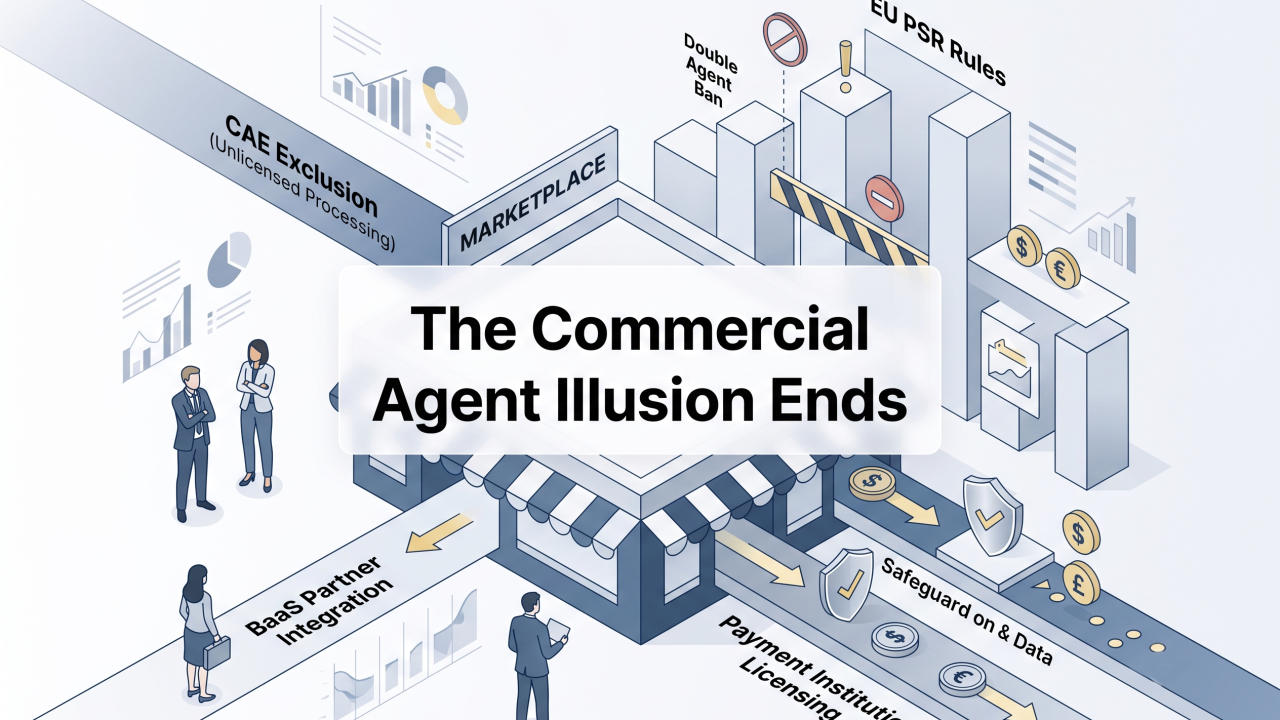
The escape route is gone. For years, digital marketplaces and software platforms relied on regulatory grey areas to split, hold, and route customer funds without holding a payment license. This strategy has failed. Under the newly finalized European Payment Services Regulation, the elimination of the commercial agent exemption means that platforms can no longer act as intermediaries for both buyers and sellers simultaneously. The margin hit is permanent.
- Primary Market Trigger – EU Payment Services Regulation, ST-8221-2026-INIT, published by the Council of the EU on April 17, 2026
- Systemic Impact – Elimination of the Commercial Agent Exclusion for multi-party digital platforms, forcing direct licensing or margin handover to regulated partners
- Operational Requirement – Mandatory integration of compliant payment architectures, transaction transparency, and direct operational substance audits
The Illusion of the Cyprus Shell and the Real Transaction Flow
The paper shell is dead. Many digital platforms established empty Cyprus entities as payment agents to shield their primary operating corporations from regulatory scrutiny. This shortcut no longer works. Because independent bank compliance teams look directly at the actual transaction data to find the ultimate source of funds, they quickly see through these artificial arrangements. The real business gets audited.
Automation destroys your legal shield. The Payment Services Regulation mandates that a legitimate commercial agent must hold real, active authority to negotiate or conclude contracts on behalf of clients. Standard terms fail this test. Setting up a postbox office in Cyprus does not alter the physical reality of a Delaware parent company managing the core platform, directing the payments, and controlling the customer interface. We trace the true parent.
The Institutional View from the Risk Committee
Risk committees seek ultimate truth. When evaluating high-risk marketplace platforms, institutional banks do not rely on generic B2B contract templates or administrative shortcuts. They analyze the entire flow. We spent hours reviewing transaction logs and treasury files to ensure that compliance risk was not being masked by offshore intermediaries or nominal corporate arrangements. Transparency is your only shield.
We reject the paper veil. Honestly, we are concerned by how many founders believe they can isolate their regulatory liabilities by signing a template contract with a shell company. Obviously, these shortcuts cause friction. If the platform cannot prove its own operational substance during our review, the risk committee will vote to terminate the relationship to protect the bank from joint liability under the new rules.
The Insider View – Part of me understands why founders take shortcuts to save time, but the part that has seen the operational fallout says wait. If a top-tier bank like Bivial will not accept your network transparency, your business should not risk working with them either. Honestly, when a client presents us with a paper shell in Cyprus while keeping their actual operations in the US, we do not see a clever structure, we see a red flag.
Systemic Reconfiguration and Substance Management
True substance requires structural reform. To secure long-term bankability under the revised Swiss AMLA standards, platforms must establish genuine local operations and clear corporate governance. This demands rigorous documentation. Every corporate file must match the highest regulatory criteria, which means you must maintain accurate transaction logs, verified director records, and clear regional entity mapping. Sloppy administration invites immediate rejection.
I verify your corporate files. As a registered Adviser under the revised Swiss AMLA, I have evaluated dozens of structures that fell apart because founders chose shortcuts over real substance. This is a fatal error. To prevent sudden account closures, you must structure your corporate files with proper titles, page numbers, revision codes, and dates to demonstrate authentic governance. Correspondent networks demand total order.
Infrastructure Management
Substance is your operational anchor. If your platform relies on nominee services to maintain its international footprint, you must understand the strict boundaries of global frameworks. Oversight must remain absolute. Nominee director services under frameworks like the UK Companies Act 2006 must be strictly capped at a maximum of ten firms to ensure total corporate oversight and prevent systemic risk. Excessive shells invite regulatory bans.
Sources Cited
- Council of the European Union, Compromise text on the Payment Services Regulation, ST-8221-2026-INIT, April 17, 2026 https://data.consilium.europa.eu/doc/document/ST-8221-2026-INIT/en/pdf
- Council of the European Union, Compromise text on the Third Payment Services Directive, ST-8222-2026-INIT, April 17, 2026:https://data.consilium.europa.eu/doc/document/ST-8222-2026-INIT/en/pdf
- Financial Conduct Authority, Payment Services and Electronic Money – Our Approach – March 2026 (Version 7): https://www.fca.org.uk/publication/finalised-guidance/payment-services-electronic-money-approach-march-2026.pdf
- European Payments Council, Verification of Payee Scheme Rulebook, Version 1.1: https://www.europeanpaymentscouncil.eu/document-library/rulebooks/verification-payee-scheme-rulebook-0
- PwC, Client Alert – EU’s New Payments Framework, April 23, 2026:https://legal.pwc.de/content/services/regcore-client-alert/pwc-client-alert-eus-new-payments-framework-april-2026.pdf
- Clifford Chance, Impact of PSD3 – Are You Ready?, April 28, 2026: https://www.cliffordchance.com/content/dam/cliffordchance/briefings/2026/04/impact-of-psd3-are-you-ready.pdf
- Ryft, PSD3: What’s Changing and How to Prepare (2026), May 19, 2026: https://www.ryftpay.com/blog/psd3-whats-changing-and-how-to-prepare-2026
- Deutsche Bank, Flow Briefing – Verification of Payee Go-Live, April 9, 2026: https://flow.db.com/files/documents/more/publications/flow-briefing/Deutsche-Bank-flow-briefing-Verification-of-Payee.pdf