
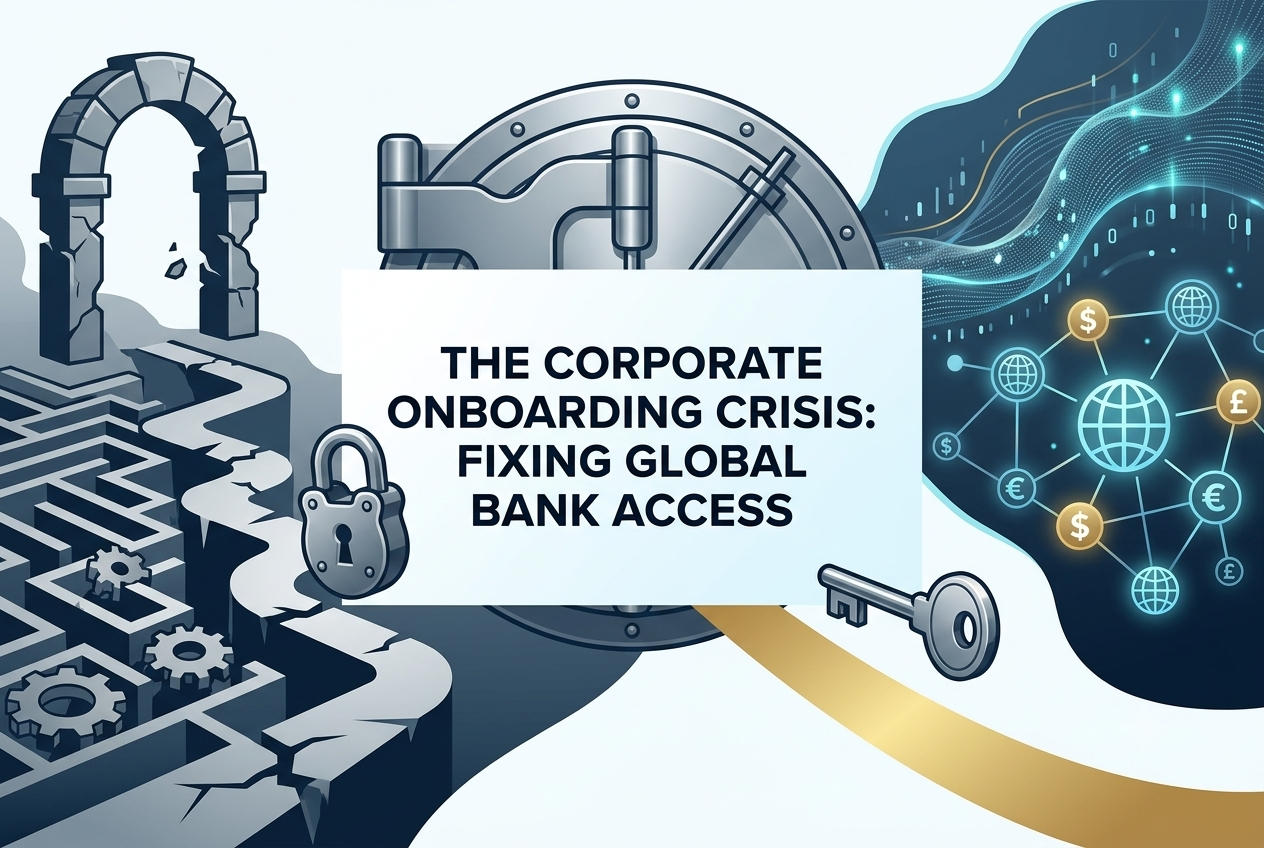
The Corporate Onboarding Crisis: Fixing Global Bank Access
Chief Financial Officers face a hidden administrative cost. About 38% of new corporate banking customers abandon account opening due to severe delays and heavy paperwork requirements.
Operations teams struggle with failed payments, and executives miss market entry deadlines. The root cause is a structural clash. Modern company networks simply break old banking software. Traditional bank systems cannot process decentralized business models. Securing reliable banking access requires global companies to map their corporate structures clearly before they apply.
Why Traditional Banks Reject Digital Businesses
Global businesses use holding companies, offshore branches, and multi-approval digital wallets to manage taxes and protect assets. Older bank software cannot handle this. Legacy systems are built for local companies with direct owners. When traditional software scans a multi-tier corporate setup, it flags the complexity as “exceeding risk appetite” and automatically rejects the application.
Global banks are accelerating this friction by cutting ties with entire regions. They do this to avoid high compliance costs and strict penalties. In 2025 alone, over 127 banks exited emerging markets. This leaves smaller local banks with very few clearing partners. To protect their remaining relationships, these local banks enforce strict rejection policies on any non-standard company. Approving a single complex client risks an alert from the Financial Action Task Force (FATF). A FATF alert can freeze a local bank’s global access immediately.
Comparing Financial Frameworks: The Onboarding Gap
| Feature | Legacy Bank Software | Modern Corporate Strategy |
|---|---|---|
| Target Client | Simple, local businesses. | Global holding companies and offshore branches. |
| Risk Approach | Automatic rejection or long review delays. | Clear, verified documents presented upfront. |
| Processing Time | 6 to 16 weeks. | Compressed to days with prepared data. |
| Digital Assets | Blanket policy rejection for web3. | Connects digital controls to legal paperwork. |
Shrinking banking networks make international payments slower and more expensive. Digital businesses are protecting their cash flow by using alternative systems. Multinational companies now send money across borders in minutes using stablecoins like USDC on public blockchains. This directly bypasses the traditional banking network and cuts reliance on legacy systems by nearly half.
The US and EU Regulatory Split
Fragmented rules in the United States and Europe create massive data gaps. The US Financial Crimes Enforcement Network (FinCEN) updated its reporting rules in 2025 to target foreign companies, leaving domestic ones unchecked. Because there is no central federal database for local US firms, bank onboarding teams must search state records manually.
In contrast, the European Union centralized its data rules. Under the 2024 EU Anti-Money Laundering Package, public access to company registers was removed to protect privacy. Financial institutions now wait 12 to 24 days to get certified ownership data. In countries like the Netherlands, outdated ownership records lead to heavy fines. Banks will eventually have to connect with digital identity wallets to fix this, but the rollout will take years.
Strict Regional Hubs and The Multi-Signature Conflict
This bottleneck is highly visible in banking hubs like Cyprus and Singapore. Setting up a company in Cyprus takes about 10 days, but opening a traditional bank account takes up to 16 weeks. Central Bank of Cyprus directives force banks to demand physical office leases and local staff before approving an account. In Singapore, local banks instantly reject applications with vague business descriptions.
Traditional compliance also relies on a single chain of command. Banks expect a simple list of authorized signers. Digital businesses often use multi-signature wallet configurations, requiring multiple independent private keys to authorize a payment. Traditional bank systems cannot process this distributed authority.
Digital platforms solve this issue using Multi-Party Computation (MPC). This technology secures digital keys using methods that match traditional accounting rules. In late 2025, the US Office of the Comptroller of the Currency (OCC) granted special approvals for institutional custody firms. Global enterprises can now hold stablecoins inside these regulated trust banks, building a payment workflow that traditional banks actually accept.
Manual document checks cause a serious cash flow crisis. Waiting 16 weeks for a bank account traps working capital and stops international growth. Roughly 80% of companies facing these delays plan to seek alternative financial partners. Fast bank access is a core competitive advantage.
The Truth About Bank Onboarding
Banks often blame onboarding delays on global regulations. This convenient excuse hides the primary cause: obsolete technology. Traditional commercial banks rely on outdated database software built in the 20th century. Banks refuse to upgrade their software to understand multi-tier holding companies. Instead, they shift the paperwork burden onto the client.
Automated rejection policies protect bank profit margins from high compliance costs. Digital businesses lose speed and money, while traditional banks maintain market power without improving their infrastructure.
A Clear Strategy for Better Bank Access
Digital business leaders must stop waiting for banks to upgrade. Securing capital access requires proactive corporate document engineering.
Tier 1: Practical Steps for Operations Teams
Operations and treasury managers can bypass automated bank rejections by implementing these immediate adjustments. Your internal team can execute this framework independently. However, partnering with an industry insider removes the guesswork. We know exactly how compliance algorithms read these files, allowing you to avoid the administrative headache and secure approval on the first attempt:
- Prepare the Registry Upfront: Map every intermediate holding company and parent entity. Ensure all documents are less than 90 days old and properly stamped by authorities.
- Use Parallel Banking: Apply to traditional commercial banks and digital Electronic Money Institutions (EMIs) at the same time. Use the fast 48-hour onboarding of EMIs to keep your business running while traditional banks take months to process your file.
- Document the Origin of Wealth: Build a clear timeline of how the company founders made their money. Use tax returns and audited balance sheets. Prove where the money came from before a bank analyst even asks.
Practitioner Checklist: Pre-Onboarding Audit
- Verify all corporate registry filings match your tax certificates exactly.
- Get official Legal Entity Identifiers (LEIs) so bank software can identify you automatically.
- Prepare a local physical file containing office leases and utility records.
- Set clear access rules on digital wallets using Multi-Party Computation tools.
Tier 2: Strategic Goals for Executives
Solving the onboarding crisis requires the C-suite to treat bank compliance as a primary business strategy:
- Diversify Your Treasury: Spread your money across traditional commercial banks, digital EMIs, and regulated digital asset networks. This stops your business from relying on a single point of failure.
- Plan a Blockchain Settlement Strategy: Use regulated stablecoins (USDC or USDT) to pay suppliers and move money internally. This reduces your reliance on slow correspondent banks by 40% to 60%.
- Design for Compliance: Avoid adding unnecessary company layers in strict regions. Ensure your tax strategy is compatible with standard bank policies before you implement it.
Questions the CFO Must Ask Today
- How much money did we lose to currency exchange fees across different banks last year?
- Can we see our real-time cash position globally, or are we still using manual spreadsheets?
- How long could we keep operating without our main bank account?
- What percentage of our working capital is currently delayed in bank settlement buffers?
Conclusion
Complex holding structures are necessary for managing taxes and securing assets. Presenting these setups to old bank systems without a clear translation strategy guarantees massive delays. Digital businesses cannot treat banking as an administrative afterthought. Packaging corporate documents into verified, easily digestible files converts a high-risk profile into a standard application. This approach secures the capital access required for global expansion.
Stop Waiting for Bank Approvals
Your treasury architecture should accelerate your growth, not block it. If your digital business is facing onboarding delays, automated rejections, or trapped working capital, you need a proactive banking strategy.